Four great friends of our family visited from Germany this summer. They returned for a 25 year reunion of their first trip to Watertown. Paul, Norbert, Andreas, and Burkhard came as student Engineers to the Watertown Air Brake Company in 1989.
They returned with their families. We had a great reunion with them and the Sheen family, other Watertown friends that now live out of the area.
Everyone came to our house for a great party. There was food, swimming, kayaking in the river, and lots of conversation. It was wonderful to see everyone and to meet in person everyone's families!
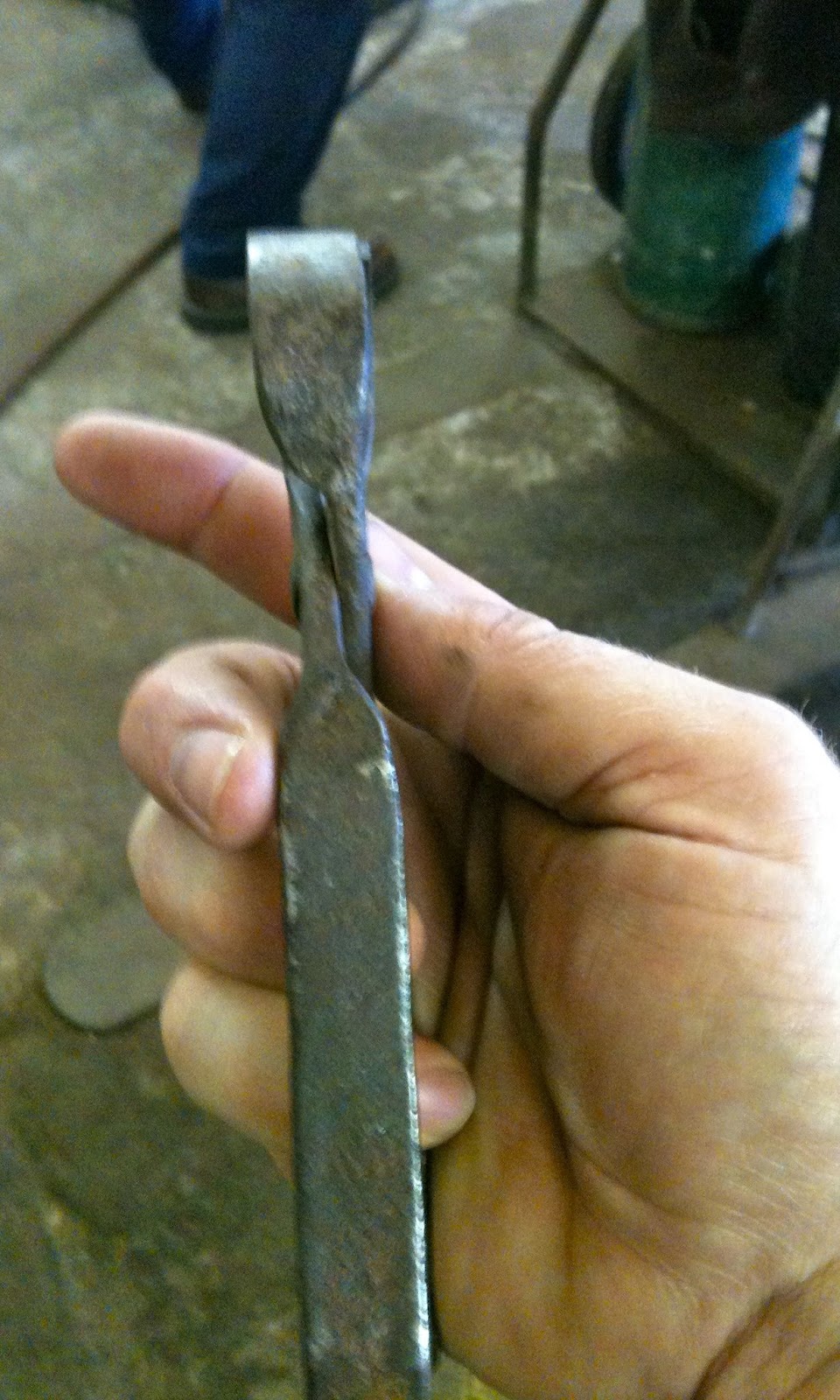
We even got to do some Blacksmithing! I had some wonderful Apprentices!
We are fortunate to have Norbert's daughter, Lena, staying with us for a couple of months. Welcome Lena!
Welcome to the Kellogg & Sons Blacksmith Shop
Our traditional Blacksmith shop located in Northern New York. We do custom Blacksmithing work focused upon traditional 18th and 19th century hardware and tools.
Monday, September 23, 2013
Thursday, September 12, 2013
Blacksmithing at the Great New York State Fair!
The E. N. Harris Blacksmith Shop was in operation from 1890 until the early 1960's. Albert and Elmer Harris ran it in the 20th century. It has been preserved as part of the Jared VanWagonen Carriage Museum on the grounds of the New York State Fair in Syracuse, NY.
I have had the good fortune to demonstrate there a day or two for the last several years during the run of the Fair. Their shop was in Williamstown, NY. It specialized in farm tools, horse shoeing, and wagon repair. The shop at the Fair is a wonderful time capsule of this type of shop. Shops like this were the backbone of rural business and industry.
Each day several thousand people go through the Carriage Museum that contains the shop. The best part is every time I demonstrate one of Albert and Elmer's Grandchildren or Great-Grandchildren visits the shop! It is nice to be part of carrying on the Harris Blacksmith Shop tradition!
It is located in the Jared VanWagonen Carriage Museum. There are great wagons, tools, and horse-drawn sleighs in the building. I like the blacksmith wagon. It is like an industrial grade kid's wagon for real farm use.
I have had the good fortune to demonstrate there a day or two for the last several years during the run of the Fair. Their shop was in Williamstown, NY. It specialized in farm tools, horse shoeing, and wagon repair. The shop at the Fair is a wonderful time capsule of this type of shop. Shops like this were the backbone of rural business and industry.
Each day several thousand people go through the Carriage Museum that contains the shop. The best part is every time I demonstrate one of Albert and Elmer's Grandchildren or Great-Grandchildren visits the shop! It is nice to be part of carrying on the Harris Blacksmith Shop tradition!
It is located in the Jared VanWagonen Carriage Museum. There are great wagons, tools, and horse-drawn sleighs in the building. I like the blacksmith wagon. It is like an industrial grade kid's wagon for real farm use.
I like Doug's Chuckwagon too! He restored it and brings it as part of a demonstration of what a working cattle drive or chuckwagon looked like.
It is fully stocked with tools, historic food crates and boxes, and gear. Harness the team, it is ready to go!
Monday, August 26, 2013
Blacksmith made Bullhead Skinner Pliers
One of the stranger tools that Blacksmiths made must be Bullhead Skinning Pliers. They are used to clean Bullhead (a type of small catfish) and remove the tough skin. They are simple and blunt-ended to hold and remove the skin without damage.
The pliers are made like a simplified set of Blacksmith's tongs. This pair was made out of steel around 3/16 thick and one inch wide. The most forging was done to make the eye for the rivet that joins the pliers. These were made by an old farmer in the 1970's.
You can see that the handle and jaw end were left full dimension of the bar while the joint was hammered to have a flat 90 degrees out of plane with the handle.
These are an interesting old tool. The forge work on them is minimal. These were not expensive. The selling price didn't justify any effort beyond that needed to get them to function. They also were used wet and are very corroded. But you can still see that their form follows function. Bullhead season is coming up. I may have to make a pair of 'skinning pliers!
!! UPDATE !!
Over twenty people a day seek out this post. Do you have some old Bullhead Pliers? I'd love a picture. Are you looking for Pliers? Why? I am curious why so many people are interested in Blacksmith Made Bullhead Pliers! Feel encouraged to comment!
Steve
The pliers are made like a simplified set of Blacksmith's tongs. This pair was made out of steel around 3/16 thick and one inch wide. The most forging was done to make the eye for the rivet that joins the pliers. These were made by an old farmer in the 1970's.
You can see that the handle and jaw end were left full dimension of the bar while the joint was hammered to have a flat 90 degrees out of plane with the handle.
These are an interesting old tool. The forge work on them is minimal. These were not expensive. The selling price didn't justify any effort beyond that needed to get them to function. They also were used wet and are very corroded. But you can still see that their form follows function. Bullhead season is coming up. I may have to make a pair of 'skinning pliers!
!! UPDATE !!
Over twenty people a day seek out this post. Do you have some old Bullhead Pliers? I'd love a picture. Are you looking for Pliers? Why? I am curious why so many people are interested in Blacksmith Made Bullhead Pliers! Feel encouraged to comment!
Steve
Thursday, August 22, 2013
Blacksmithing, Wile E. Coyote, and the Acme Anvil Corp.
Any 5 year old boy can tell you who is the coolest but least successful Blacksmith!
I have to admit that as a kid I loved the Warner Bros. cartoons. This is still how I draw my Blueprints.
Wile. E. Coyote and the ACME Anvil Corp. were Saturday morning regulars.
It was the Blacksmithing tools that my neighboring Farmers had it their barns that got me interested in Blacksmithing, but the ACME Anvil Corp. didn't hurt my interests!
Be safe! Respect the sign!
Those Coyotes are Wiley!
Tuesday, August 20, 2013
Teaching and Blacksmithing. A return to my Home Blacksmith Shop!
As many of my friends know I worked for almost 6 years at the Farmers' Museum in Cooperstown.
That involved commuting 130 miles each way and staying away from home for 5 days at a time. I am now focusing on teaching and Blacksmithing closer to home in Dexter! I am happy to be home in the North Country, but miss all the friends I made while in southern NY. It is time to get Kellogg & Sons going again! My Great-Grandfather started his business by that name in 1921.
What are my plans now? Some teaching, Blacksmithing, historic smithing projects, and having a little fun. I definitely plan on more Kayaking and fishing this year.
I have barely gone the last 5 years even though the Black River is in my back yard. I can fish for every major North American gamefish within walking distance. This Pickerel was caught 6 feet off my back yard.
I'm going fishing!
Saturday, April 28, 2012
Buffalo Forge Blacksmith's Forge with hank cranked blower.
Recently I picked up an old coal forge in good shape to add to my Blacksmith shop.
This size of cast iron forge would have been common in shops between 1900 and the 1950's. Buffalo forge was one of the largest manufacturers of forged, and is still a major maker of air handling equipment.
This forge has a very smooth working hand-cranked blower. It works well, turns smoothly, and is fairly quiet. Often an old blower is loud, temperamental, and loud! I got lucky.
This size of cast iron forge would have been common in shops between 1900 and the 1950's. Buffalo forge was one of the largest manufacturers of forged, and is still a major maker of air handling equipment.
This forge has a very smooth working hand-cranked blower. It works well, turns smoothly, and is fairly quiet. Often an old blower is loud, temperamental, and loud! I got lucky.
Friday, March 2, 2012
Pattern Welding billets and Power Hammer work with the Adirondack Blacksmiths!
The Adirondack Chapter of the NewYork State Designer Blacksmiths had a great hammer-in on Feb. 11th, 2012. About a dozen guys participated in making pattern welded billets for knife making. A special thanks goes out to Bob Cunningham for hosting, Dan Dufore for preparing the materials, and our Forgemaster Marty Snye for helping to organize this event.
Bob
Dan
The billets were made of 13 layers of 1080 and 15N20. Both are around .8 carbon and seemed to have very similar heating and expansion rates. That made the forge welding process easier. The stack were mig welded together and were around 1.25 wide, 4" long, and 1.5" high.
We heated the billets in coal forges. After a good soak to come up to heat they were brushed and fluxed. Then when they reached welding heat they were welded with a gentle pass through Bob's Big Blue air hammer. They welded up nicely. The hammer had good control and we used it to it's full capacity.
We had a mix of experienced smiths and learners. Even guys who had never welded before got their billets welded. There were cases of not using enough flux or hitting too hard and delaminating the weld, but most were quickly overcome. Any project like this is always a major learning experience! So we had "learning experiences" that taught us what happens when you get the billet too hot, and what happens when you work it too cold!
I did get a billet welded up to 117 layers. Now I need to decide what I am going to make with it! It was a fun day! Thanks to Bob and his family for hosting the Hammer-in!
Bob
Dan
The billets were made of 13 layers of 1080 and 15N20. Both are around .8 carbon and seemed to have very similar heating and expansion rates. That made the forge welding process easier. The stack were mig welded together and were around 1.25 wide, 4" long, and 1.5" high.
We heated the billets in coal forges. After a good soak to come up to heat they were brushed and fluxed. Then when they reached welding heat they were welded with a gentle pass through Bob's Big Blue air hammer. They welded up nicely. The hammer had good control and we used it to it's full capacity.
We had a mix of experienced smiths and learners. Even guys who had never welded before got their billets welded. There were cases of not using enough flux or hitting too hard and delaminating the weld, but most were quickly overcome. Any project like this is always a major learning experience! So we had "learning experiences" that taught us what happens when you get the billet too hot, and what happens when you work it too cold!
I did get a billet welded up to 117 layers. Now I need to decide what I am going to make with it! It was a fun day! Thanks to Bob and his family for hosting the Hammer-in!
Subscribe to:
Posts (Atom)